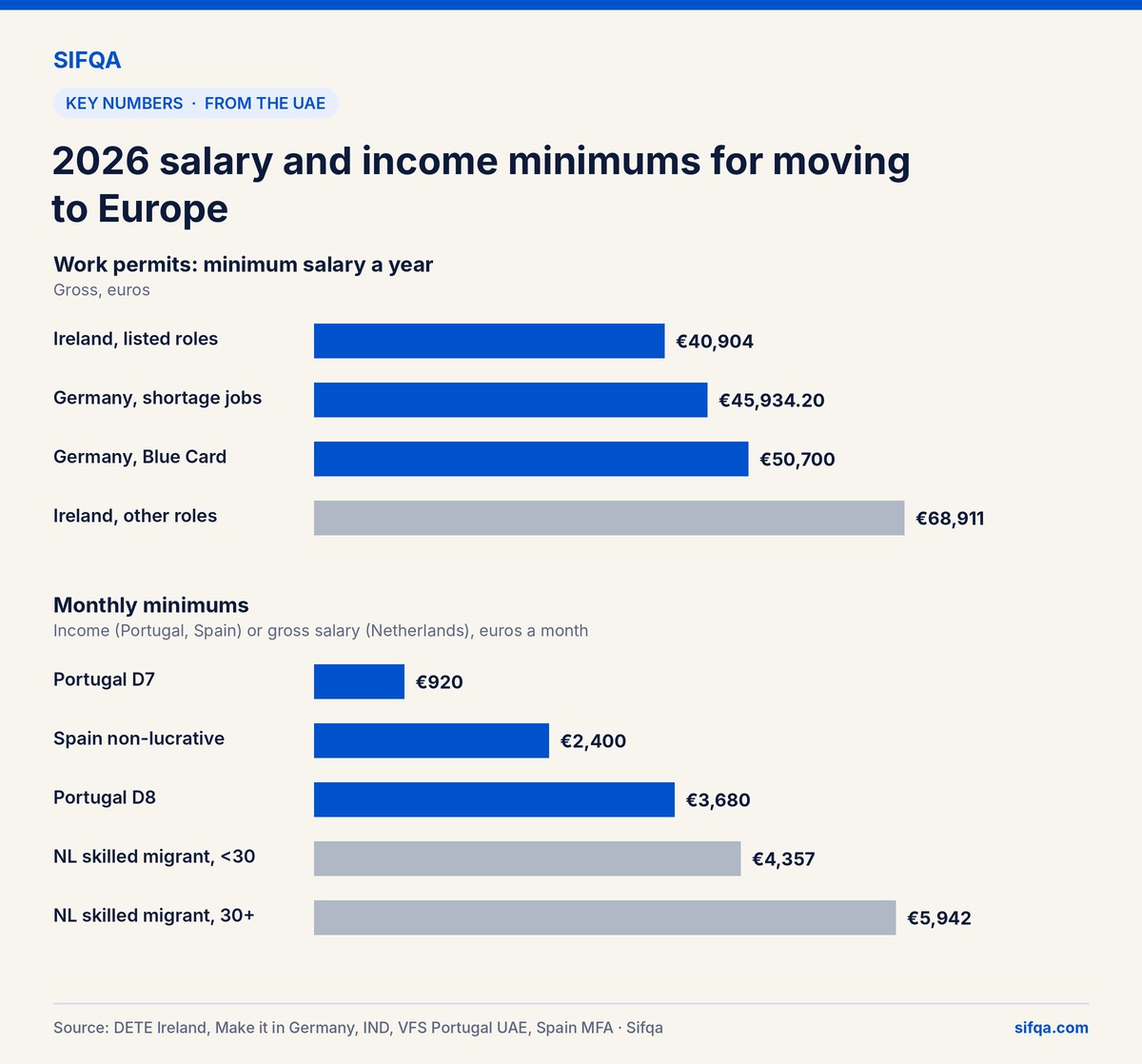
There are five legal routes for a UAE resident to move to Europe: a job offer with a work permit, a job-search visa, a self-funded or remote-work visa, a study visa, or a family route. For most expats, the job-offer route is the fastest. In 2026 it means a salary of at least €40,904 a year in Ireland (Critical Skills, degree-level roles), €45,934 to €50,700 a year in Germany (EU Blue Card) or €5,942 a month in the Netherlands (Highly Skilled Migrant, age 30+). If you can live on passive income or remote work, Portugal and Spain are the main options.
Thresholds checked on 4 November 2026 against government and official provider sources listed at the end. Your passport decides whether you need a visa to enter. Your UAE residence decides where you apply: you normally lodge a long-stay (national “D”) visa at the embassy or visa centre in the UAE, not in your home country.
What are the ways to move to Europe from the UAE?
| Route | Who it suits | Main examples | Can you work? |
|---|---|---|---|
| Job offer + work permit | Professionals with a degree or in-demand skills | Germany EU Blue Card, Netherlands Highly Skilled Migrant, Ireland Critical Skills | Yes, for the sponsoring employer at first |
| Job-search visa | Skilled workers without an offer yet | Germany Opportunity Card | Limited part-time and trial work |
| Self-funded (passive income) | Retirees, landlords, investors, people with savings income | Portugal D7, Spain non-lucrative visa | Portugal D7: yes; Spain non-lucrative: no |
| Remote work / digital nomad | People employed or freelancing for clients outside the destination country | Portugal D8, Spain digital nomad visa | Yes, for your foreign employer or clients |
| Study | Students and career changers | Master’s degrees in Germany, the Netherlands, Ireland, France | Limited hours during study |
| Family | Spouses and children of EU citizens or of permit holders | EU free-movement rules; national family reunification | Usually yes |
Investment (“golden visa”) routes still exist in a few countries, but they are expensive and changing fast. Spain closed its golden visa in April 2025. Portugal’s golden visa no longer accepts property purchases. These routes are outside the scope of this guide.
Salary and income thresholds by country (2026)
| Country and visa | Minimum you must show | Approx. in AED | Need a local job offer? |
|---|---|---|---|
| Ireland Critical Skills Employment Permit | €40,904 a year (listed degree roles); €68,911 a year (other roles) | About AED 165,000 / AED 278,000 a year | Yes, 2 years minimum |
| Germany EU Blue Card | €50,700 a year; €45,934.20 for shortage jobs and recent graduates | About AED 204,000 / AED 185,000 a year | Yes |
| Netherlands Highly Skilled Migrant | €5,942 a month (30+); €4,357 a month (under 30), excluding holiday allowance | About AED 24,000 / AED 17,500 a month | Yes, with an IND recognised sponsor |
| Portugal D7 (passive income) | €920 a month (2026 minimum wage) | About AED 3,700 a month | No |
| Portugal D8 (digital nomad) | €3,680 a month (4 × minimum wage) | About AED 14,800 a month | No; employer or clients must be outside Portugal |
| Spain digital nomad visa | About €2,849 a month (200% of the 2026 minimum wage) | About AED 11,500 a month | No; mainly foreign employer or clients |
| Spain non-lucrative visa | €28,800 a year (€2,400 a month), plus €7,200 per dependant | About AED 9,700 a month | No, and you may not work |
AED amounts are rounded at about AED 4.03 to €1 and are for budgeting only. Consulates assess the amount in euros.
How to move to Europe from the UAE: step by step
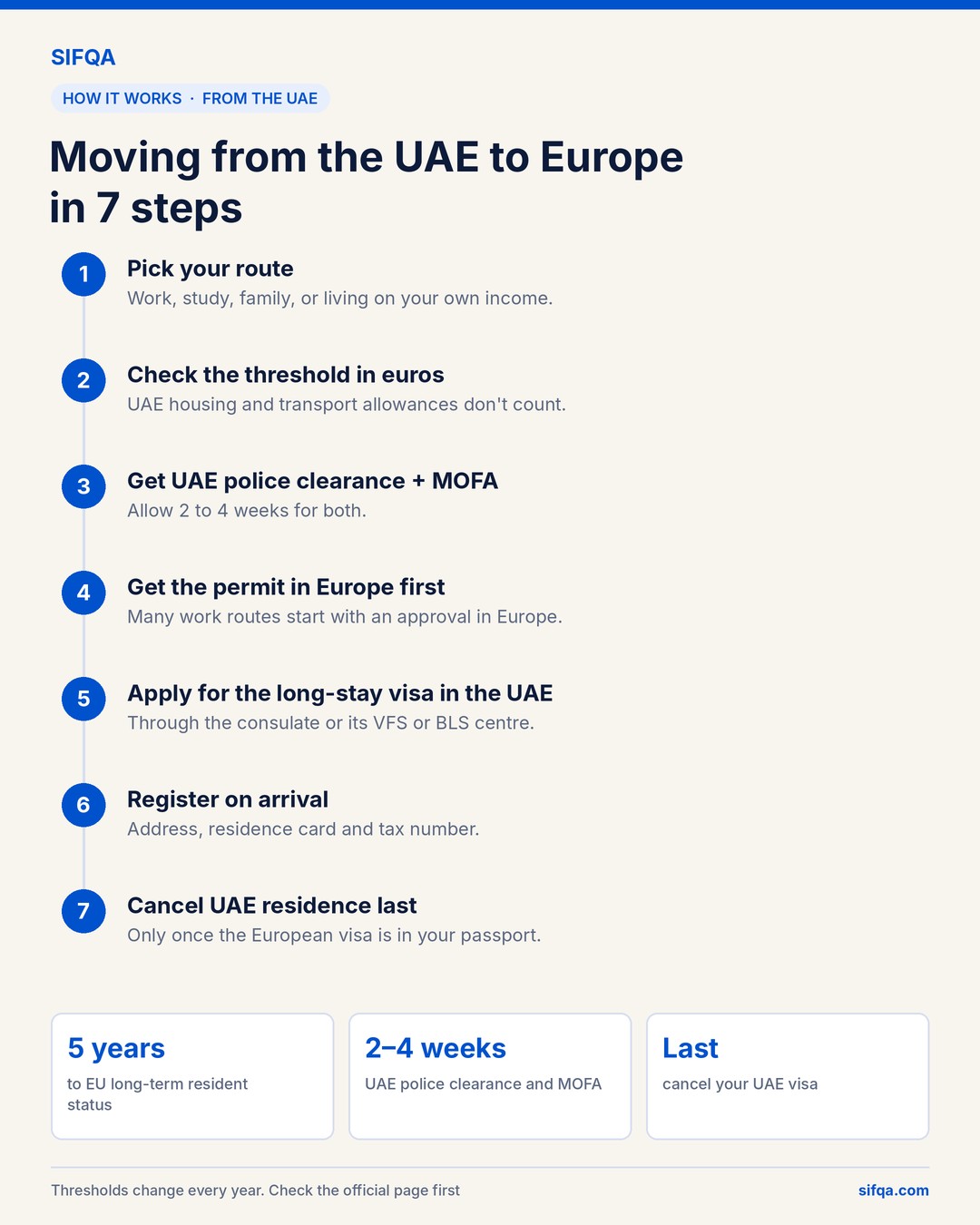
- Pick the route that fits your situation. Do you have a job offer, a degree in a shortage field, remote income or passive income? This matters more than the country.
- Check the threshold in euros. UAE salaries often include housing and transport allowances. A European permit counts only the gross salary paid by the European employer, or your proven income for self-funded visas.
- Prepare UAE documents early. Get a UAE police clearance certificate and, where asked, have it and your degree attested by the UAE Ministry of Foreign Affairs (MOFA). This step alone can take 2 to 4 weeks.
- Get the permit or approval in Europe first, if your route needs one. For work routes, the employer (Netherlands) or you or the employer (Ireland) apply in that country. You then apply for the entry visa in the UAE.
- Apply for the long-stay visa in the UAE. Book at the consulate or its visa centre (VFS Global or BLS International) for your emirate. Keep your UAE residence valid throughout.
- Register on arrival. Every country requires local registration and a residence card within days or weeks of arrival.
- Close your UAE life in the right order. Cancel your UAE residence only after the European visa is in your passport. Collect your end-of-service gratuity and close or keep your bank account deliberately.
Work routes: Germany, the Netherlands and Ireland
A work permit is tied to a real job offer from an employer in that country. A UAE employer cannot sponsor you for a European work permit. Each of these three countries has its own guide on Sifqa:
- Germany: EU Blue Card with a recognised degree, or the points-based Opportunity Card to job-hunt in Germany. See Germany Opportunity Card and Blue Card from the UAE.
- Netherlands: the employer must be an IND recognised sponsor and applies for you; the decision usually comes in weeks. See Netherlands Highly Skilled Migrant visa from the UAE.
- Ireland: English-speaking, with a direct route to Stamp 4 (free to work) after about two years. See Ireland Critical Skills Employment Permit from the UAE.
The United Kingdom is no longer in the EU, but it is still a common move from the UAE. See the UK Skilled Worker visa from the UAE.
Self-funded and remote-work routes: Portugal and Spain
These routes do not need a European job, so they suit people who already earn remotely, run a business, own rental property or are retiring.
- Portugal D7: regular passive income of at least €920 a month, a Portuguese bank account and accommodation in Portugal. The D8 digital nomad visa needs €3,680 a month from remote work. See Portugal D7 and Digital Nomad Visa from the UAE.
- Spain digital nomad visa: about €2,849 a month in 2026 from an employer or clients mostly outside Spain, with at least three months of prior work for them.
- Spain non-lucrative visa: €28,800 a year in savings or passive income for the main applicant. Work is not allowed. See Spain digital nomad and non-lucrative visa from the UAE.
What changes because you apply from the UAE
| Issue | What to do |
|---|---|
| Where you apply | At the consulate or visa centre in the UAE that covers your emirate. Non-Emiratis must show a valid UAE residence permit. |
| Police clearance | Usually from the UAE and from your country of nationality. Portugal asks for the UAE certificate to carry a MOFA stamp. See UAE police clearance for immigration. |
| Degree | Germany checks recognition; Ireland and the Netherlands mainly look at the job and salary. Keep attested copies ready. See degree assessment from the UAE. |
| UAE income | Counts for Portugal D8 and Spain’s digital nomad visa if your UAE employer lets you work remotely. It does not count for work permits. |
| Tax | Once you live in Europe you usually become tax resident there and may be taxed on worldwide income. Get tax advice before you move. |
| UAE visa timing | Do not cancel your UAE residence before you hold the European visa. See the leaving-the-UAE checklist. If you stay outside the UAE for over six months first, read the six-month rule. |
How long until permanent residence or citizenship?
Most EU countries grant EU long-term resident status after five years of continuous legal residence. Citizenship takes longer and varies by country. Portugal raised its naturalisation period to 10 years for most nationalities (7 for EU and Portuguese-speaking countries) from 19 May 2026. Ireland’s Critical Skills holders can switch to Stamp 4 after about two years. Years spent living in the UAE do not count towards any of these totals.
How to avoid relocation scams
- No real employer sells a job offer. Paying an agent in Dubai for a “European work visa” or “job guarantee” is a warning sign.
- Check the employer yourself. Dutch employers must appear on the IND’s public register of recognised sponsors. Irish permits are issued by the Department of Enterprise, Tourism and Employment.
- Pay government fees to the government. Fees go to the authority or its official visa centre, never to a personal account.
- A Schengen visit visa is not a work visa. Working on a 90-day visa can get you banned from the whole Schengen area.
Questions people ask
What is the easiest European country to move to from the UAE?
With a job offer, Ireland and the Netherlands have the fastest employer-led processes. Without one, Portugal’s D7 has the lowest income requirement at €920 a month in 2026.
Can I move to Europe from Dubai without a job offer?
Yes. Germany’s Opportunity Card lets you job-hunt in Germany, and Portugal’s D7 and D8 or Spain’s digital nomad and non-lucrative visas are based on your own income.
Do I apply in the UAE or in my home country?
If you legally live in the UAE, you normally apply at the consulate or visa centre in the UAE. Some approvals, such as Dutch and Irish work permits, are first issued inside that country.
Does my UAE salary count for a European work permit?
No. Work permits count the salary from the European employer. UAE income only helps for remote-work and self-funded visas.
Do I need ETIAS to move to Europe?
No. ETIAS is a future travel authorisation for short visits by visa-exempt nationals and was not yet operating in October 2026. Moving needs a long-stay visa or residence permit.
Can my family move with me?
Work-permit holders in the Netherlands and Ireland can usually bring a spouse and children quickly. Portugal now makes most D7 and D8 holders wait before applying for a spouse, although children are exempt.
Related guides
- Portugal D7 and Digital Nomad Visa from the UAE
- Netherlands Highly Skilled Migrant visa from the UAE
- Ireland Critical Skills Employment Permit from the UAE
- Germany Opportunity Card and EU Blue Card from the UAE
- Spain digital nomad and non-lucrative visa from the UAE
- How to find a job in Europe from the UAE
- Leaving the UAE for Europe: the complete checklist
- Renting a home in Europe from the UAE
- Health insurance for European visas from the UAE
- Opening a bank account in Europe from the UAE
- Exchanging a UAE driving licence in Europe
- Study in Europe from the UAE
- Moving to Europe as the spouse of an EU citizen
- Degree recognition for Germany from the UAE
- Visa application centres in the UAE by country
Sources
- Department of Enterprise, Tourism and Employment (Ireland): Critical Skills Employment Permit
- Meijburg & Co (KPMG Netherlands), summarising IND figures: 2026 salary criteria for highly skilled migrants
- VFS Global for the Embassy of Portugal in the UAE: D7 checklist
- French Ministry for Europe and Foreign Affairs: EES and ETIAS
- Germany 2026 Blue Card figures: EU Blue Card minimum salary 2026
Written by Asad Waleed M, Dubai. Asad has lived in the UAE for nine years and researches visa rules from government sources. He is not an immigration lawyer or consultant, and Sifqa does not process applications or sell visa services. Read the editorial policy.
Last checked 4 November 2026. Thresholds change every year, usually on 1 January. Found an error? Email [email protected] and it will be fixed and logged.